What are the Interior Design Styles?

Interior design styles are the shared language that describes the line, material, colour and feel of a space: modern, contemporary, minimalist, classic, art deco, industrial, Scandinavian, japandi, rustic, bohemian and mid-century. A style describes the line; words such as luxurious, plain or stylish are not styles but the atmosphere a space gives off.
Umut GÜRLER Interior Architecture has run villa, apartment, office and clinic projects in Ankara since 2009 (more than 17 years). This page defines each style briefly, lists what sets it apart and gives examples from our own project archive.
What are the interior design styles and how do they differ?
An interior design style is the overall look that appears when line, material and colour choices point the same way; names like modern or classic label it. Several styles can sit together in one room, but a project's main line is usually described with a single style.
The table below sums up the eleven styles with their defining line and the elements you most often see. Style names are not only a classification; they give you and the designer a shared reference. The same living room can have classic moulding or modern contrast, and which one fits depends on the scale of the space, the way the user lives and the budget.
| Style | Defining line | Common elements |
|---|---|---|
| Modern | Distinct line and contrast; a full, decisive look | Warm wood, full-bodied seating, glossy surfaces, an accent colour |
| Contemporary | Plain, clean, neutral; less assertive than modern | Neutral tones, little ornament, flat surfaces, current materials |
| Minimalist | Bare surfaces, hidden detail, very few objects | Hidden handles and LEDs, single-colour surfaces, empty space |
| Classic (neoclassical included) | Symmetry, proportion and traditional ornament | Moulding, cornice, panelling, chandelier, gold detail |
| Art deco | Geometric pattern and glossy surfaces | Marble, mirror, brass and gold, round and symmetrical forms |
| Industrial | Inspired by factory and warehouse spaces | Raw concrete, exposed brick, black metal, visible services |
| Scandinavian | Light tones, natural materials, functional simplicity | Light wood, white surfaces, wicker and wool textures |
| Japandi | Japanese simplicity with Scandinavian warmth | Low furniture, natural wood, earth tones |
| Rustic | Natural, unfinished surfaces | Stone, raw wood, wicker, plants |
| Bohemian | Layered, colourful, handmade textures | Patterned fabric, plants, pieces from different periods |
| Mid-century | A plain, functional furniture line that spread between 1945 and 1970 | Wooden-legged armchairs, flat-front cabinets, organic forms |
We cover which styles stand out in villas in a separate article, popular interior styles in villas.
How do modern, contemporary and minimalist styles differ?
Modern and contemporary are often confused, but they are separate lines. Modern is a full, decisive look built with a distinct line and contrast, warm wood, full-bodied seating and an accent colour. Contemporary is plainer: it stays current with neutral tones, clean surfaces and little ornament, but it is not as assertive as modern.
An example of the modern line is Beysu Konakları - Flat: the corner sofa, the wood-panelled TV unit, the gold-veined marble floor and the hidden ceiling LEDs give the living room a distinct identity.

An example of the contemporary line is Santra Villa - Serdar Bey: a large island, tall stools, pendant lamps and a glass facade opening to the garden. The surfaces stay plain and the attention goes to the openness of the space.

The minimalist style is one step barer: surfaces are left empty, detail is hidden and objects are few. For its origins see the Minimalism article on Wikipedia. In practice the difference reads like this: as objects and detail drop you move from contemporary to minimalist, and as contrast and accent rise you move from contemporary to modern. The examination room of the Bd Dent clinic sits between these two lines: an oval doctor desk, a glass partition, a ceiling-mounted monitor and few objects. We described how the minimal line is built in a villa in Villa Decoration Trend: Minimal Style. When choosing among the three lines, how the space is used decides: a busy family living room carries the warmth of modern better, while a calm study or examination room carries contemporary and minimalist plainness better.

How do you recognise classic, neoclassical and art deco styles?
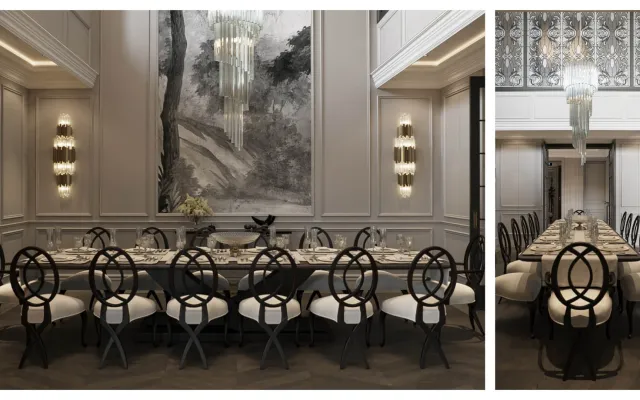
The classic style joins symmetry and proportion with traditional ornament: panelled walls with moulding, cornice, coffered ceilings, chandeliers and gold detail mark this line. Neoclassical is not a separate heading but sits inside classic; it is a simplified classic that draws on ancient Greece and Rome and arose as a reaction to the heavy ornament of Baroque and Rococo (Wikipedia: Neoclassical architecture). That is why in our projects neoclassical is described inside the classic line rather than as its own heading.
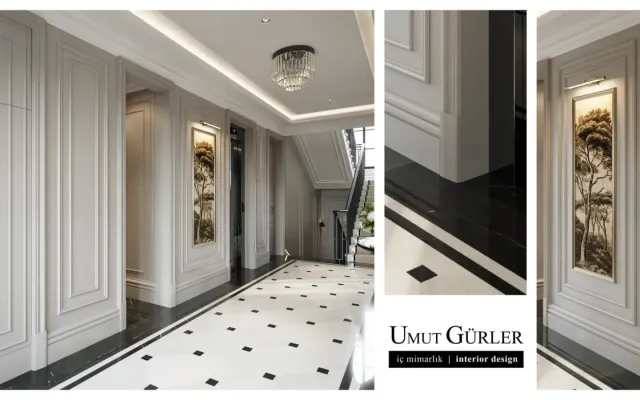
Example: Bilkent Konut Projesi. A black-and-white diamond-pattern marble floor, moulded walls, hidden LED ceiling and a crystal ceiling light set the entrance hall on a classic axis. We described the office counterpart of the same line in Classic Style Lawyer Office Decorations.

Art deco also loves ornament, but through geometry: round and symmetrical forms, marble, mirror and brass or gold detail. The movement, which began in France, takes its name from the 1925 Paris exhibition (Wikipedia: Art Deco). Ea Natura Konut Projesi carries classic and art deco together; Yeni Batı Villa is mostly a modern villa, yet its entrance hall shows the art deco influence with a round form, a ring chandelier and arched mirrors. Classic and art deco can meet in one project; although their ornament can look alike, classic works through proportion and symmetry and art deco through geometry and glossy surfaces. Knowing this difference makes it clear which reference suits a project.

Current project: İncek House


İncek House
Which spaces suit industrial, rustic and bohemian styles?
The industrial style takes its inspiration from factories and warehouses: raw concrete, exposed brick, black metal and visible services are part of its language. It is common in offices, cafes and loft-type homes (Wikipedia: Industrial style). In Office Building Design the black slatted ceiling and linear lights point to the industrial side, while the surfaces stay contemporary. We described how the two lines meet in an office in Combination of Industrial and Modern Style in Construction Company Office Design.

The rustic style is built from natural, unfinished surfaces: stone, raw wood, wicker and plants. It works in a restaurant as well as at home because it gives a warm, relaxed feel. In Saraçoğlu Restaurant the hanging plants, wooden surfaces, cushioned chairs and pergola ceiling bring a rustic warmth inside a modern layout.

The bohemian style is layered: patterned fabrics, pieces from different periods, plants and handmade textures. The idea goes back to the way artists lived outside accepted norms in nineteenth-century Europe (Wikipedia: Bohemianism). Our archive has no fully bohemian project; the bohemian influence shows as touches that soften a contemporary frame with warm, colourful pieces. This route is used when the base of the space stays plain and layers are added on top. The industrial line stresses hard surfaces and the rustic line warm, raw textures; used together, wood and plants beside concrete and brick take the chill off the space.
How do Scandinavian, japandi and mid-century styles differ?
The Scandinavian style is an approach of simplicity, function and natural materials that was born in the Nordic countries and spread in the mid-twentieth century (Wikipedia: Scandinavian design). Light wood, white surfaces, and wicker and wool textures stand out. In the bedroom of A. Turan House a black iron bed, cream bedding, botanical pictures and a wicker pendant light build a simplicity between Scandinavian and rustic.

Japandi joins Japanese simplicity with Scandinavian warmth (Wikipedia: Japandi). Low furniture, natural wood and earth tones define it. In the living room of Incek House - Casa Pino a modular sofa, wooden coffee tables, a wicker rug and a double-height volume bring a japandi touch on top of a contemporary frame.

Mid-century modern is a clean-lined, unornamented furniture line that spread roughly between 1945 and 1970 (Wikipedia: Mid-century modern). Wooden-legged armchairs, flat-front cabinets and organic forms are typical. Our archive has no project that carries mid-century as a separate style; this furniture approach sits at the root of the modern line and its influence shows indirectly in the clean-lined seating of modern projects. All three styles lean on plainness but from different places: Scandinavian on light and pale colour, japandi on low and natural forms, and mid-century on the silhouette of the furniture itself. So the same cream-toned living room can be built in three different ways; the height, material and leg form of the furniture set them apart.
How does atmosphere differ from style?
Atmosphere is the feel a space gives at first glance; style is the line that creates that feel. Luxurious, plain, stylish, airy, corporate, dark and warm are not styles but atmospheres. The same style can carry different atmospheres: a classic living room can feel luxurious with gold and crystal, or plain with light tones and few objects.
| Atmosphere | How it is built | Example project |
|---|---|---|
| Luxurious | Gold, brass, marble, crystal chandelier | Ea Natura Konut Projesi |
| Plain | Few objects, flat surfaces, neutral colour | Okcuoglu Construction Company Office Design |
| Stylish | Balanced proportion, refined detail | Bilkent Konut Projesi |
| Airy | Light tones, wide glazing, high ceilings | Atabilge Villa - B Type |
| Corporate | An orderly, measured, work-focused layout | Law office design |
| Dark | Dark surfaces and contrast | Santra Villa - Ismet Bey |
| Warm | Wood, soft light, textured fabric | Santra Villa - Serdar Bey |
When describing a project it is enough to name the main style first, a second style if needed, and then at most three atmospheres; for example "classic, luxurious and stylish" or "contemporary, plain and airy". Gold, brass or leaf detail brings the luxurious atmosphere; for executive room examples see Luxury Style Executive Room Examples. The choice of atmosphere moves with colour, light and material; it is possible to soften or sharpen the feel of a space without changing its style.
Which interior design style suits my home?
Choosing a style is not about a fashion but about the scale of the space, the daily routine of the user and the budget. These questions help when you decide:
- How large is the space and how much light does it get? In a small, dim room contemporary or Scandinavian light tones feel calming; a wide, high living room can carry the full look of classic or modern.
- How busy is daily life? A household with many objects clashes with a minimalist layout; storage must be planned from the start.
- Care and durability: marble, tufted fabric and gold detail need care; wood, matt surfaces and neutral fabric are more forgiving.
- Budget: classic ornament (moulding, cornice, custom-cut panels) is labour-heavy; with plain surfaces the investment goes into material quality.
- Household and habits: in a home with children, rounded furniture and easy-to-wipe surfaces stand out; in a home that often hosts guests, a wide seating plan does.
You do not need to know the style name; showing three or four photos you like is enough for a first meeting. We gathered what to look for when choosing the right interior architect in Interior architecture companies in Ankara.
Author note: Umut GÜRLER Interior Architecture has worked in Ankara since 2009 (more than 17 years). The style definitions and project examples on this page come from our own archive; the external links are for the general history of the styles.
Let Umut Gürler Interior Architecture Be Your Style Consultant
Umut Gürler Interior Architecture - Ankara Interior Architecture does not apply one template to every taste. We listen to the brief and produce a solution for that brief. Since 2009 we have been glad to stand beside clients with a team that cares about design quality and satisfaction. Fees vary by person and project scope; this page does not publish a net figure. You can contact us about the topic and the budget. We look for a suitable path together.
For more writing on interior architecture, browse our articles. To see completed work, review the references page.
Frequently asked questions about interior design styles
What are the interior design styles?
The main styles are modern, contemporary, minimalist, classic, art deco, industrial, Scandinavian, japandi, rustic, bohemian and mid-century. Neoclassical is not counted as a separate style; it is described inside classic.
Are modern and contemporary styles the same?
No. Modern builds a full look with a distinct line, contrast and an accent colour; contemporary is plainer, more neutral and less ornamented. Contemporary sits between modern and minimalist.
What is the difference between neoclassical and classic style?
Neoclassical is a simplified classic that draws on ancient Greece and Rome and arose as a reaction to the heavy ornament of Baroque and Rococo. In our projects it is described inside the classic line, not as a separate heading.
Is luxurious or plain a style?
No, it is an atmosphere. The same classic or contemporary line can feel luxurious with gold and marble, or plain with neutral tones. Style describes the line; atmosphere describes the feel a space gives.
Can more than one interior design style be used at the same time?
Yes. In projects the main style is often joined by a second one; for example a classic entrance hall and a modern living room can share a villa. A shared material and colour palette ties the styles together.